
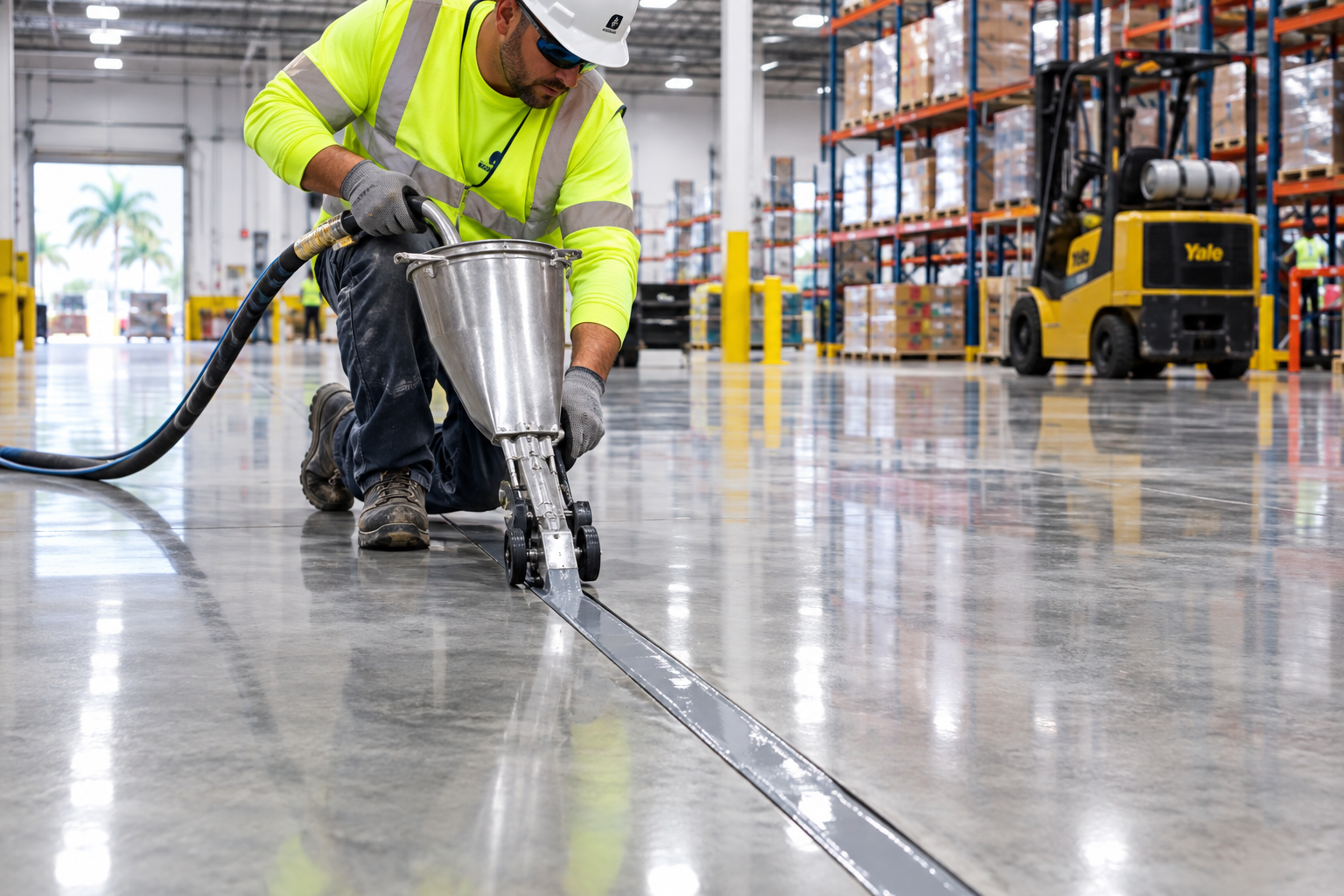
As the heavy rains and tropical storm threats of South Florida’s wet season finally begin to taper off, warehouse operators, distribution center directors, and facility managers across Broward and Miami Dade counties face a critical operational window. Transitioning from storm recovery to the dry season provides the ideal environment to tackle crucial infrastructure upgrades. While roof leaks and exterior water intrusion dominate management concerns during the summer months, the hidden casualties of a grueling wet season are often right beneath your feet: your industrial concrete floors and joint systems.
For logistics hubs operating out of Fort Lauderdale, Miami, and Davie, unconditioned concrete slabs take a relentless beating. Between heavy daily forklift traffic, sub slab moisture migration driven by high water tables, and thermal expansion, industrial floors require targeted attention to prevent minor cracks from turning into major operational liabilities. Investing in professional industrial concrete repair Fort Lauderdale FL and timely maintenance ensures your facility stays safe, compliant, and structurally sound heading into the peak shipping season.
The Aftermath of South Florida’s Wet Season on Warehouse Slabs
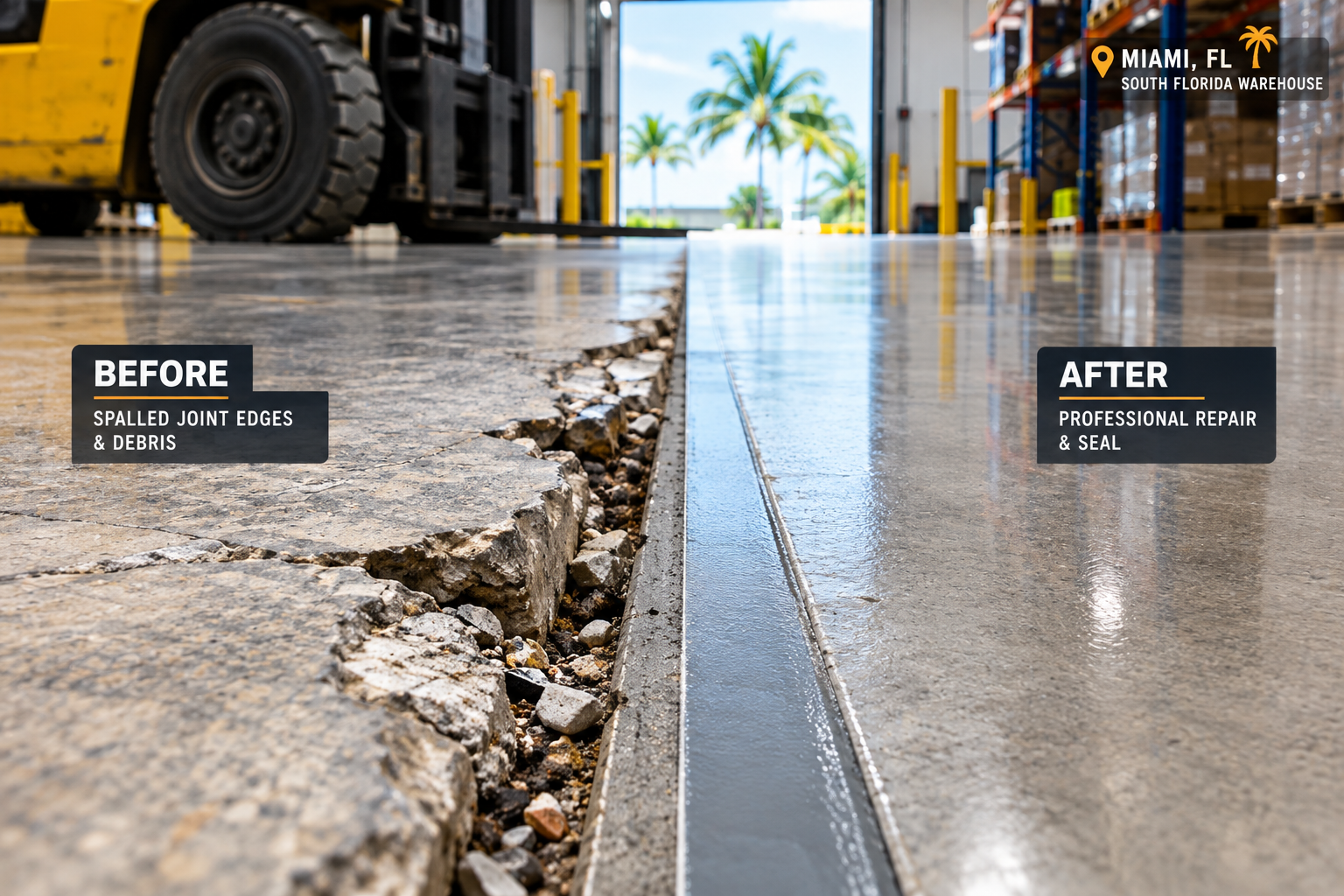
South Florida’s environment introduces unique geological and atmospheric challenges for industrial real estate. During the summer wet season, frequent torrential downpours saturate the ground, elevating the water table and driving sub slab hydrostatic pressure upward. This continuous moisture pressure forces water vapor through porous concrete slabs, creating severe chemical and physical stress.
When moisture mixes with unsealed concrete or penetrates to internal steel reinforcement, it triggers concrete spalling and rebar corrosion. Furthermore, constant dynamic loading from multi ton forklifts, pallet jacks, and heavy inventory racks accelerates the degradation of control joints and slab edges. Left unchecked, damaged concrete floors create severe hazards:
- Forklift Wheel and Equipment Damage: Potholes, spalled joints, and chipped slab edges inflict severe shock on material handling equipment, leading to premature tire wear, alignment issues, and expensive suspension repairs.
- Employee Safety Hazards: Uneven walking surfaces and cracked concrete dramatically increase the risk of slips, trips, and falls, exposing facility owners to serious OSHA compliance violations and liability claims.
- Concrete Dust Contaminant Risks: Unsealed, degrading concrete constantly sheds fine dust particles. In sensitive distribution environments such as electronics, food and beverage, or pharmaceutical storage this airborne dust fouls inventory and damages automated machinery.
Transitioning your facility maintenance strategy right now means addressing these vulnerabilities head on through structured slab crack repairs and joint sealant renewal.
1. Comprehensive Slab Crack Repairs and Structural Restoration
When cracks develop in a high traffic industrial warehouse floor, ignoring them is never a viable option. In South Florida’s moisture laden environment, a hairline crack quickly expands as water infiltrates the sub base, washing away compacted soil and causing slab deflection under heavy point loads.
Professional concrete slab restoration Broward County involves a systematic evaluation of crack severity and underlying structural integrity:
- Routing and Epoxying Static Cracks: For non moving cracks, contractors use diamond blade saws to route out the crack, cleaning away debris before injecting high strength, low viscosity epoxy resins. This restores full structural monolithic strength to the slab.
- Addressing Dynamic and Working Cracks: If cracks are subject to thermal movement, flexible polyurea or polyurethane joint fillers are utilized to accommodate ongoing expansion and contraction without tearing away from the concrete interface.
- Full Depth Spall Repair: Where forklift impacts have broken away chunks of concrete around column bases or loading bays, damaged material must be saw cut, chipped out, and patched using rapid setting, high compressive strength polymer modified mortars.
By executing these repairs during the dry season when ambient humidity and slab moisture levels drop to their annual lows contractors achieve optimal chemical bonding and long term durability.
2. Warehouse Floor Joint Sealant Renewal in Miami
Control joints and construction joints are intentionally engineered into industrial concrete slabs to control random cracking caused by concrete shrinkage as it cures. However, these joints are also the weakest points in a warehouse flooring system.
In busy Miami distribution centers, joint filler takes heavy abuse. As steel wheeled forklifts slam across unsealed or deteriorated joints, the concrete shoulders (lips) begin to spall and break down. Once joint filler sags, cracks, or disappears entirely, debris and moisture fill the void, accelerating localized failure.
Upgrading to high performance warehouse floor joint sealant Miami solutions provides essential protection:
- Installing Semi Rigid Polyurea Joint Fillers: Traditional asphalt based or low grade caulks cannot withstand heavy industrial loads. Modern industrial applications rely on high shore hardness polyurea joint fillers that support the edges of the concrete when heavy forklift wheels roll across them, eliminating joint edge breakdown.
- Deep Joint Cleaning and Debris Removal: Before new sealants are applied, existing failing materials must be completely plowed out and cleaned via mechanical scraping or abrasive blasting to ensure a flawless bond.
- Preventing Sub Slab Moisture Ingress: Properly sealed joints prevent washdown water, chemical spills, and surface moisture from migrating into the sub base, protecting the structural integrity of your entire facility foundation.
3. Dust Proofing and High Performance Floor Coatings
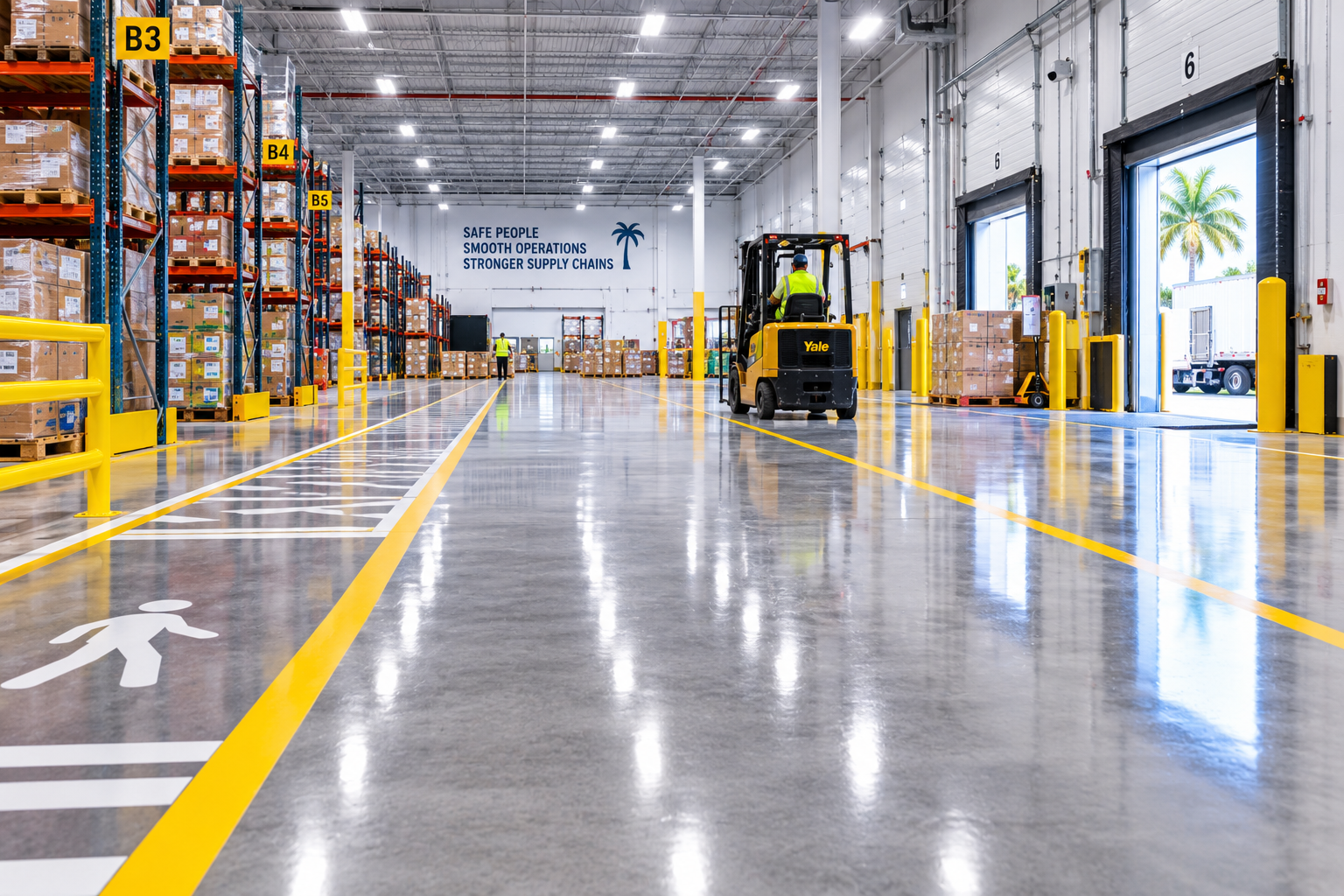
Once structural cracks are healed and joints are renewed, the final step in preparing your warehouse for peak dry season operations is surface protection and dust proofing. Bare industrial concrete is inherently porous and constantly sheds micro dust under high frequency foot and vehicular traffic.
Upgrading your floor finish transforms a high maintenance hazard into a high performance asset:
- Liquid Chemical Hardeners and Densifiers: Penetrating densifiers react chemically with free lime in the concrete, creating a hard, dense crystalline structure that completely stops concrete dusting, seals pores against oil absorption, and simplifies daily cleaning.
- High Performance Epoxy and Polyaspartic Coatings: For staging areas, assembly lines, and high traffic aisles, high build epoxy or fast curing polyaspartic coatings provide chemical resistance, enhanced slip resistance, and bright, reflective finishes that improve overall facility illumination and safety.
- Clear Safety Demarcation: Integrating high visibility yellow and white line striping during your floor upgrade ensures loading docks, pedestrian walkways, and racking clearance zones remain clearly defined and OSHA compliant.
Partnering with South Florida’s Industrial Experts
Navigating facility enhancements between seasonal shifts requires a specialized local contractor who understands the complex demands of South Florida’s climate, building codes, and rapid operational schedules. Foersch Contracting provides turnkey industrial contractor services ranging from precision concrete restoration and joint sealing to high performance floor coatings and structural repairs tailored specifically to logistics hubs across Fort Lauderdale, Miami, and Davie.
Don’t let deferred concrete maintenance compromise your supply chain or lead to premature equipment failures. Protect your facility, safeguard your workers, and optimize your warehouse floor for the busy dry season ahead.
Need a certified team to handle your warehouse floor restoration? Contact Foersch Contracting today to schedule a comprehensive structural slab audit and keep your South Florida facility operating at peak performance.